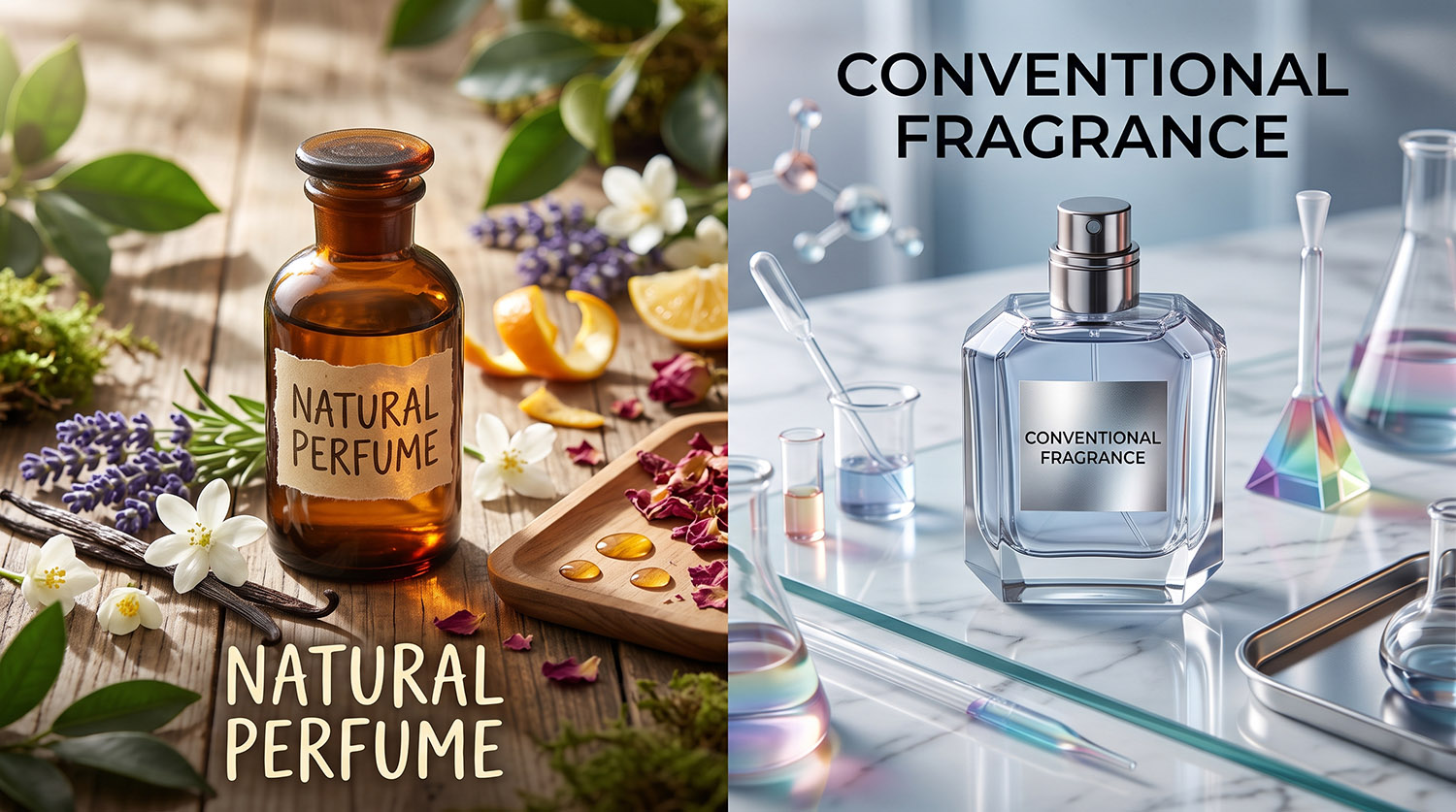
What is a natural perfume made from pure essential oils? At its most specific, it is a wearable fragrance whose scent composition is built only from whole essential oils, then diluted in a suitable perfume base such as a plant oil or alcohol. That definition matters because natural perfume is a broader category, and not every product marketed as natural is essential oil only.
TL;DR
A perfume made from pure essential oils uses concentrated botanical extracts as its aromatic ingredients rather than synthetic fragrance compounds. It may still contain a carrier oil, ethanol, water, wax, or other non-aromatic base materials. “Pure” describes the essential oils used, not an instruction to apply undiluted oils directly to skin. The most reliable way to assess a product is to read the full ingredient list, ask whether it contains isolates or synthetic aroma chemicals, and consider its intended use.
Table of contents
Defining pure essential oil perfume
The narrow meaning behind the phrase
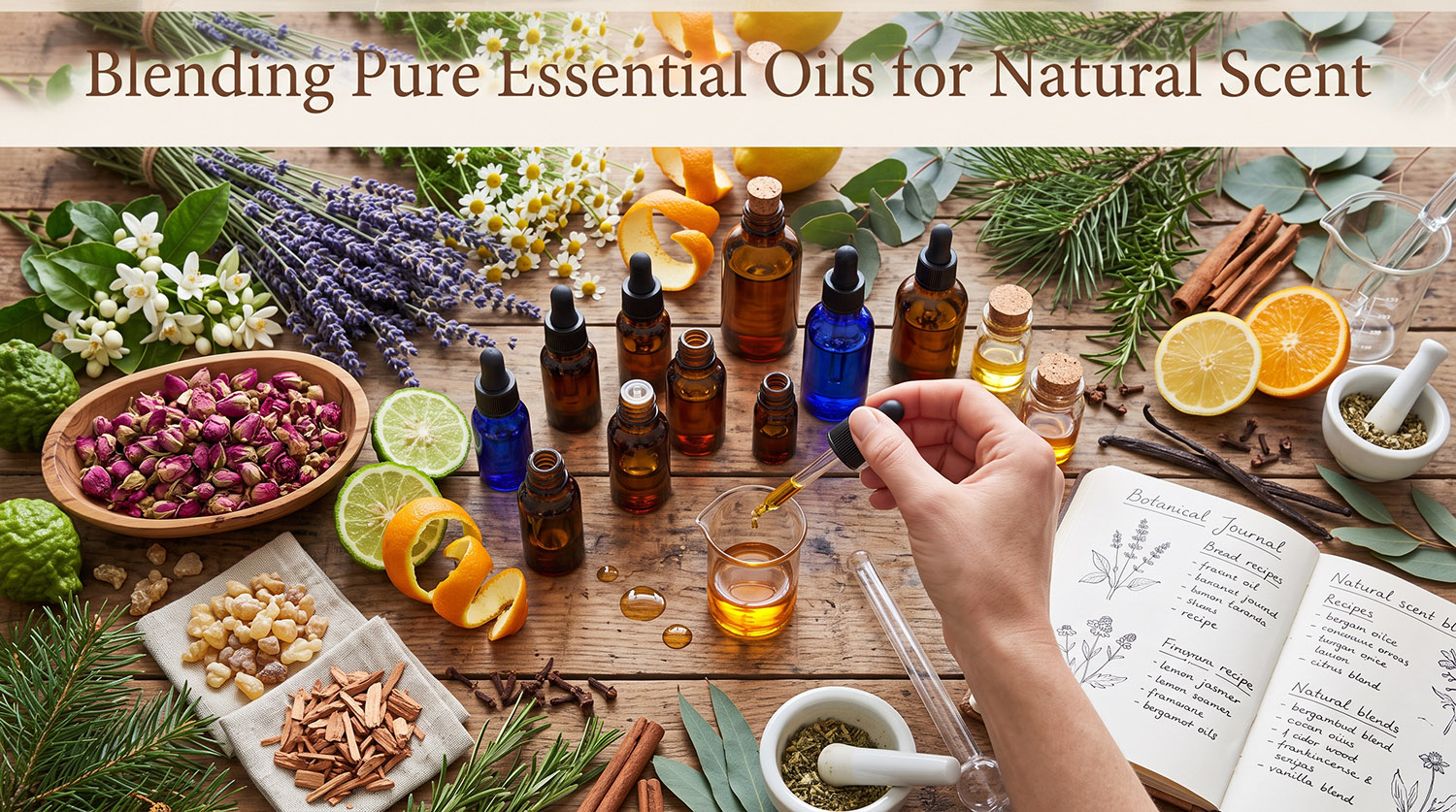
A natural perfume made from pure essential oils is a fragrance formula in which the aromatic portion comes from whole essential oils. These are concentrated, volatile botanical materials extracted from plants. A cedarwood oil, for example, carries an aromatic profile obtained from wood; a citrus oil captures aromatic compounds from peel; a floral oil may come from petals or other plant material.
This is narrower than the phrase natural perfume. Natural perfume can include essential oils, absolutes, tinctures, infusions, CO₂ extracts, resins, and other botanical aromatic materials. Those ingredients can all be plant derived, but they are not all essential oils.
That distinction helps prevent a common misunderstanding. A perfume can be genuinely natural while containing a rose absolute, vanilla CO₂ extract, benzoin resin, or botanical tincture rather than relying exclusively on essential oils. Conversely, a product labeled “made with essential oils” may include essential oils alongside other aromatic materials unless the brand specifically states that its fragrance composition is essential oil only.
What “pure” does and does not mean
In fragrance language, pure essential oil generally means the oil itself has not been diluted with a carrier or substituted with a synthetic fragrance oil. It does not mean that the finished perfume should contain 100 percent essential oil.
Essential oils are highly concentrated. A skin-worn perfume needs to be designed around its format, the specific ingredients involved, the application area, and the intended frequency of use. A roll-on perfume, for instance, usually combines aromatic materials with a carrier oil so that application is controlled and comfortable. A spray perfume may disperse the aromatic blend in ethanol.
A useful distinction: pure can describe the condition of an ingredient; safe wearable concentration describes the finished formula.
We can think of it like concentrated coffee: the beans may be pure, but the prepared drink is still diluted to be consumed as intended.
Botanical origin is not the same as “untouched”
Natural ingredients are processed. Steam, pressure, cold pressing, filtration, and blending all shape the raw material before it reaches a perfume bottle. That processing does not automatically make an ingredient synthetic.
Natural perfumery uses aromatic materials derived from nature, while essential oils are concentrated extracts from multiple plant parts, including flowers, leaves, stems, bark, roots, seeds, fruits, woods, spices, and resins.
The more useful buyer question is not “Was this processed?” but “What was processed, how was it extracted, and what else was added to the formula?”
How essential oils become a wearable perfume
Extraction determines the raw material
Essential oils are not one uniform type of ingredient. Their extraction method depends on the plant material and affects the aromatic result.
| Extraction method | Commonly used for | What happens | Why it matters in perfume |
|---|---|---|---|
| Steam distillation | Leaves, woods, roots, herbs, some flowers | Steam carries volatile aroma compounds from plant material, which are then condensed and separated | Often produces a clear, concentrated oil with a recognizable but sometimes altered version of the plant’s aroma |
| Cold pressing | Citrus peels | Mechanical pressure releases aromatic oil from the peel | Preserves the bright peel character, but some citrus oils need careful formulation for leave-on skin use |
| Expression or mechanical extraction | Certain peels and plant materials | Physical pressure releases aromatic compounds without heat-heavy distillation | Can retain fresh, lively notes that may be especially volatile |
| CO₂ extraction | Delicate botanicals, spices, resins | Carbon dioxide under pressure draws out aromatic constituents | Creates a botanical extract, but it is not necessarily an essential oil |
Steam-distilled lavender, patchouli, cedarwood, frankincense, and vetiver are familiar examples of essential-oil materials. Cold-pressed bergamot, lemon, and sweet orange are common citrus materials. Each has a different evaporation rate, chemical profile, and use limitation.
A formula based entirely on whole essential oils is shaped by those inherent differences. Bright citrus materials often appear first and fade sooner. Denser wood, root, and resin oils may remain closer to the skin for longer. This is not merely a matter of top, middle, and base notes; it is a consequence of volatility, molecular weight, concentration, and how the blend interacts with skin and its base.
The carrier is part of the product, not a loophole
A natural essential-oil perfume can contain a base without becoming less essential-oil based. The base is usually there to dilute the scent materials, support application, and determine the product format.
| Finished perfume format | Typical base materials | Application experience | What to check |
|---|---|---|---|
| Roll-on perfume oil | Jojoba, fractionated coconut, or another stable vegetable oil | Close-to-skin, controlled placement at pulse points | Full carrier-oil disclosure and skin-use guidance |
| Alcohol spray | Ethanol, sometimes water | Wider diffusion and a quicker-drying feel | Whether alcohol is denatured appropriately for cosmetic use and whether fragrance ingredients are disclosed |
| Solid perfume | Vegetable oils and waxes | Balm-like application, usually low diffusion | Wax type, carrier oils, and heat sensitivity |
| Attar-style oil perfume | Often oil-based aromatic blend | Concentrated, dabbed or rolled onto skin | The term alone does not prove an essential-oil-only formula |
A real product example makes the point clearly. A whole-essential-oil, no-isolate perfume can still list ethanol, water, and glycerin in its finished formula. Those ingredients are part of the carrier system, not necessarily the fragrance itself.
For shoppers who prefer the intimacy of oil application, it can be useful to explore our range of perfume oils. An oil format does not need an aerosol-like scent trail to function as perfume; it is designed for a more personal application ritual.
Why whole oils can vary
Whole botanical materials are living-source ingredients. Weather, soil, harvest timing, plant variety, extraction conditions, and storage can influence their aroma. That means a natural perfume may show subtle batch variation even when a formula is carefully repeated.
This is not necessarily a defect. Still, it is a trade-off worth understanding. A consumer expecting every bottle to smell mechanically identical may prefer a formula with tightly standardized materials. A consumer who values whole botanical character may accept slight variation as part of using plant-derived extracts.
Reading labels without relying on vague claims
Claims that need a closer look
Words such as clean, botanical, green, non-toxic, and natural-inspired do not establish what is actually in a perfume. They may describe a marketing position, but they do not answer whether the fragrance contains whole essential oils, botanical extracts, isolates, synthetic aroma chemicals, or a mixture.
When evaluating a perfume made from pure essential oils, look for clear answers to these questions:
- Does the brand identify the aromatic materials as essential oils?
- Does it state whether the formula includes fragrance isolates?
- Does it explicitly exclude synthetic fragrance or synthetic aroma chemicals, if that matters to you?
- Are carrier ingredients such as jojoba oil, ethanol, water, glycerin, or wax named?
- Are allergen disclosures and use instructions available?
- Does the product specify whether it is a roll-on, spray, solid perfume, or another format?
The phrase “parfum” on an ingredient list can be difficult to interpret by itself. It may refer to a fragrance mixture without revealing whether that mixture is essential-oil-only, includes natural isolates, or contains synthetic materials. A transparent brand can still use fragrance labeling required in its market while offering more detail elsewhere on the product page or packaging.
For a broader explanation of those claims, read what makes a perfume truly natural. The key is to treat “natural” as a starting point for questions, not final proof of a formula’s contents.
Essential oil only versus synthetic fragrance
The difference is not simply that one fragrance is “good” and the other is “bad.” They are different formulation approaches.
| Consideration | Essential-oil-only perfume | Conventional synthetic fragrance |
|---|---|---|
| Main scent materials | Whole essential oils from botanical sources | Often laboratory-made aroma chemicals, sometimes combined with natural materials |
| Aroma range | Constrained by available botanical extracts and their natural composition | Can include scent effects not readily available from plant extracts |
| Batch consistency | May vary slightly with botanical supply | Often designed for high consistency |
| Longevity tools | Relies on essential-oil selection, concentration, base, and natural fixative materials | May use high-impact aroma chemicals engineered for diffusion or persistence |
| Skin considerations | Still requires ingredient-specific safety assessment | Still requires ingredient-specific safety assessment |
The essential point is this: natural does not automatically mean allergen-free, gentler, or universally safe. Fragrance allergy and irritation can occur with botanical ingredients as well as synthetic ones. “Allergen-free” is also a specific claim that should not be assumed from the word natural.
Performance, application, and safe use
Why essential-oil perfume may wear differently
A perfume based on whole essential oils may feel less forceful than a conventional spray because many essential oils are naturally volatile. They evaporate as they meet warm skin and air. A blend may open with sparkling citrus, move into herbs or florals, then settle into woods, roots, or resins close to the skin.
Synthetic fragrance can include materials selected specifically for diffusion, stability, or long-lasting impact. An essential-oil-only perfume works with a more limited aromatic palette. That is not an automatic weakness, but it does make expectations important.
Users discussing essential oil perfumes in r/essentialoils report shorter longevity, although the discussion does not provide controlled wear-time data. The practical lesson is simple: evaluate a perfume based on your own wear needs rather than assuming “natural” guarantees either short or long performance.
If you want a scent that remains present all day, choose a fragrance with deeper woods, resins, roots, or balsamic materials and be open to reapplication. If you prefer a quiet scent for close settings, a roll-on perfume can be a better fit than a high-diffusion spray.
Safety is material-specific
There is no universal dilution percentage that makes every essential oil safe for every perfume. A sensible formula considers the ingredient, concentration, leave-on use, where it will be applied, sunlight exposure, and the user’s personal sensitivity.
Fair warning: certain citrus-derived materials may require extra caution in leave-on products because some can increase the risk of light-related skin reactions. Other materials may carry sensitization concerns, particularly with repeated exposure. Oxidized oils can also be more likely to cause problems than fresh, properly stored oils.
A patch test can be a useful precaution, but it has limits. It may help identify an immediate individual reaction on a small area, yet it cannot guarantee that sensitization will never develop later. Stop using a perfume if irritation occurs, and seek medical advice for persistent or serious symptoms.
Avoid applying fragrance to broken, inflamed, or freshly shaved skin. People who are pregnant, managing a skin condition, using prescription topical treatments, or concerned about allergies should consider professional medical guidance before using fragranced products.
Storage protects the scent profile
Essential oils react to heat, light, and oxygen over time. Keep perfume tightly closed, away from direct sun and high heat. Dark glass packaging can reduce light exposure, while a secure cap limits unnecessary air exchange.
Do not store a perfume on a sunny windowsill or in a hot car. If the scent changes sharply, becomes unusually harsh, or develops an off note, it may be time to stop using it. This is especially relevant for citrus-forward blends, which can be more prone to noticeable change as they age.
For a botanical floral example in an oil format, natural perfume oil roses shows how an essential-oil perfume can be presented as an intimate, skin-applied fragrance rather than a conventional spray.
Key takeaways
• A natural perfume made from pure essential oils uses whole essential oils as its fragrance materials, but the finished product may also contain a carrier oil, alcohol, water, glycerin, or wax.
• “Natural perfume” is broader than “essential-oil-only perfume” because natural perfumery may also use absolutes, tinctures, resins, infusions, and CO₂ extracts.
• Pure essential oils should not be confused with undiluted skin application. Wearable perfume requires formulation appropriate to the specific materials and product format.
• Botanical origin does not make a fragrance automatically allergen-free or suitable for every user.
• Whole essential oils can vary by crop, origin, extraction, and storage, which may create subtle batch-to-batch scent differences.
• Transparent labeling should explain both the aromatic ingredients and the finished perfume base, rather than relying only on broad terms such as “natural” or “clean.”
Frequently asked questions
Not always. Essential-oil-only perfume is one type of natural perfume, but natural perfume can also include botanical materials such as absolutes, resins, tinctures, infusions, and CO₂ extracts. Check whether a brand says only essential oils if that specific formulation standard matters to you.
Yes. Alcohol can serve as the base in a spray perfume while essential oils provide the scent. The presence of ethanol does not by itself mean the fragrance is synthetic. What matters is the identity of the aromatic ingredients and the full formula disclosure.
Yes. Carrier oils are common in roll-ons, waxes are common in solid perfumes, and ethanol, water, or glycerin may appear in spray formulas. These materials affect application and texture; they are separate from the perfume’s aromatic composition.
They should not be assumed to be. Pure essential oils are concentrated raw materials, and a skin-worn perfume is usually diluted into a carrier or formulated at an intended use concentration. The safe level depends on the exact oil and product type, not a single universal rule.
Some citrus materials need special care because they can contribute to phototoxic reactions when worn on sun-exposed skin. This depends on the particular oil, its extraction method, and its concentration. Follow the manufacturer’s directions and avoid treating all citrus oils as interchangeable.
Many essential oils are naturally volatile, meaning their aroma compounds evaporate readily. Conventional fragrances may use materials designed for stronger diffusion or persistence. Choosing an oil perfume with woods, roots, resins, or balsamic notes may offer a slower dry-down, but exact wear time still depends on the formula and your skin.
Look beyond “made with essential oils.” Review the ingredient list, product description, and brand disclosures for terms such as whole essential oils, no isolates, and no synthetic aroma chemicals. If the information is unclear, ask the brand directly what forms the fragrance concentrate and whether any isolates or synthetic fragrance materials are included.
Sources and references
• NPA Business Certification and Natural — What is Natural Perfume? https://npacertification.com/what-is-natural-perfume/
• Aromatic Medicine School — The Foundations of Natural Perfumery https://aromaticmedicineschool.com/wp-content/uploads/2024/05/The-Foundations-of-Natural-Perfumery.pdf
• Amacyn Perfumes — Herbaceous Fresh Organic Perfume, No Isolates https://www.amacynperfumes.com/natural-perfume/herbaceous-fresh-organic-perfume-no-isolates
• Reddit, r/essentialoils — Essential oil perfumes https://www.reddit.com/r/essentialoils/comments/1iiqwyz/essential_oil_perfumes/